
Two weeks ago I wrote about Moltbook -- a messy, fascinating glimpse of agents at scale. Then I wrote about Dario Amodei's essay and the uneasy feeling that capability growth is outpacing society's ability to adapt.
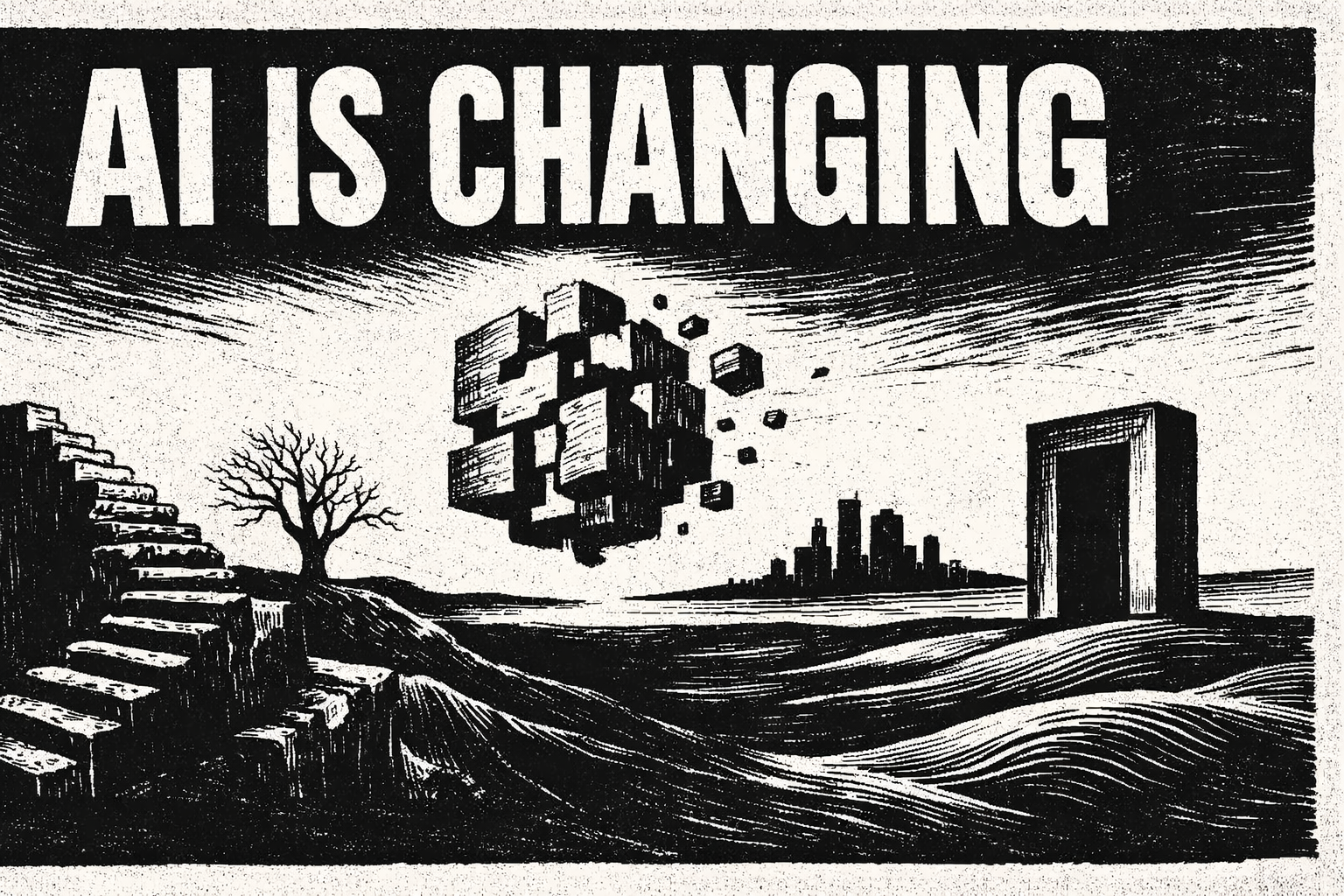
This week feels different. Not because the models got "magically smarter," but because the way AI is being used is changing. Less sci-fi. More plumbing.
Here's my take on what's actually happening right now, and what it means if you're building.
Three signals that matter
1) Claude is becoming a workflow layer
Anthropic just pushed Cowork further into enterprise territory with agentic plug-ins. The headline isn't "cool new feature," it's where the AI sits in the stack. When AI can live inside real tools and handle repeatable tasks, it stops being a novelty and starts looking like infrastructure.
This is the difference between a chatbot and a control room. It changes adoption because people don't have to "go use AI." It shows up inside the work.
2) AI is getting serious in science
DeepMind's AlphaGenome shows the other direction of progress: not just better assistants, but models that help explain the world. It can analyze long stretches of DNA and predict how changes might affect gene regulation -- a very unglamorous, very important problem.
This is the part of AI I'm most optimistic about. It's not just productivity. It's tools that make it easier to do real science faster and with more confidence.
3) Big infrastructure players are all-in
Cisco's AI Summit happening today is a good signal. When infrastructure companies, cloud providers, and hardware leaders are on the same stage, it usually means the industry is moving from experimentation to deployment.
That's not hype. That's a shift in who's buying, who's integrating, and who's responsible when things break.
So what does this mean?
To me, it means we're moving from "AI as demo" to "AI as system."
When AI becomes part of the workflow layer, the stakes change. Users stop tolerating hallucinations. Security and privacy stop being "later." UX gets judged by the same standards as any other serious product.
This also makes Dario's warnings feel less abstract. If AI is everywhere, the gaps in safety, policy, and incentives matter more. And they matter now, not after we've "perfected the models."
A builder's POV (what I'm optimizing for)
I'm trying to keep three things true in every product decision:
-
Reliability > cleverness. It's better to ship a smaller capability that works every time than a magical feature that fails unpredictably.
-
Tight loops beat broad scopes. Narrow workflows with fast feedback outperform wide, vague "AI assistant" experiences.
-
Trust is the product. If someone's journaling, planning, or making decisions, the UX has to make them feel safe and in control.
These aren't AI-specific principles. They're product principles. But they matter more when the system is probabilistic.
Where this leaves me
I'm still excited -- but I'm also more intentional. The "cool" stage is over. The "responsible" stage is starting.
If you're building right now, here's the short list I keep coming back to:
- Does this feature improve real outcomes, or just look impressive in a demo?
- Can a user explain why the system did what it did?
- If the AI is wrong, can the user recover easily?
If the answers are clear, you're on solid ground.
This is a follow-up to the Moltbook post and the Dario Amodei essay recap. If you read those, this is the next piece of the same thread.
Thanks for reading.